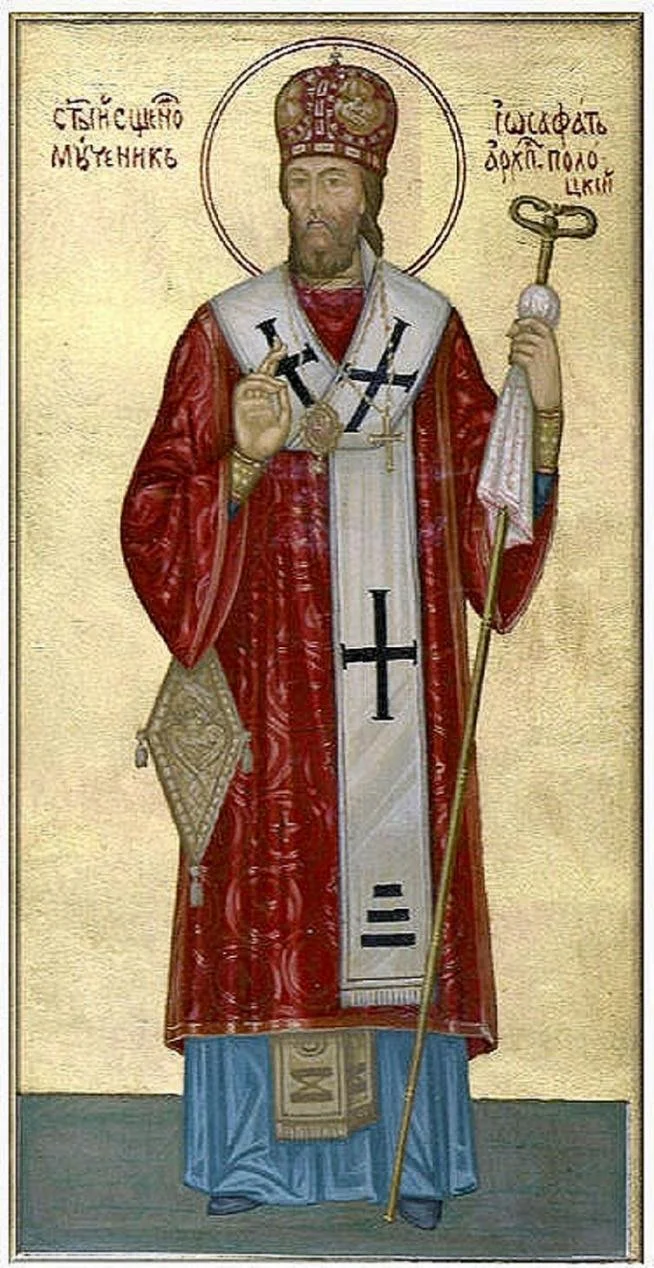
Saint Josaphat Kuncevyc
Archbishop and Martyr
(1584-1623)
Archbishop and Martyr
Saint Josaphat was born John Kuntsevych, the son of a poor nobleman, in the early 1580s in Volodymyr in the Polish Kingdom of the Polish-Lithuanian Commonwealth. His mother often took him to church, where they prayed before the crucifix. When his mother explained the significance of the crucifix, of the great love of Jesus who suffered and died for our sins, John/Josaphat later recalled, “At that very moment, I saw a spark of fire leave the side of Jesus and enter my heart. Suddenly I was filled with indescribable sweetness and love, so that I became motionless, unable to see or hear anything. Such an intense love for our Savior and Rite enkindled my heart, that for thirty years I have never missed Church services. My only thought was of how I might better imitate our Savior’s life of poverty and suffering.”
From that time on, John showed extraordinary piety and love for prayer, spending hours in his parish church. Even when sent to apprentice with a merchant in Vilno in Lithuania, he devoted his free time to prayer and reading spiritual books. At the end of his apprenticeship, John chose to enter the Basilian Holy Trinity Monastery in Vilno in 1604.
John’s early adulthood overlapped with a time of great change in the Ruthenian (Ukrainian) Church. Since the Great Schism of 1054, the Church had been divided into the Western Latin under the Pope in Rome and the Eastern Orthodox under the Patriarchs. But in 1595, the Union of Brest reunited the Orthodox Ruthenians (Ukrainians) in the Kingdom of Poland with the Church in Rome. There were segments of Ruthenian society that did not accept the union, however, and the controversy created major strife.
After joining the Holy Trinity Monastery, which under the Basilians was united with the Holy See in Rome, John took the religious name Josaphat and continued to live a life of ascetism and prayer. In 1609 he was ordained a priest, becoming well-known for his preaching. He was active among the people, visiting the sick and prisoners and helping the poor. In addition to pursuing his spiritual life and his pastoral duties, Josaphat took on various administrative roles in the monastery.
The Church noticed his abilities and work and ordained Josaphat a bishop. Shortly afterward he was named the Archbishop of Polotsk (a city today in Belarus). Defending Church unity, Josaphat employed kindness and humility in his catechetical instruction to overcome people’s animosity toward Rome and convert them to the Union. At the same time, he guarded the continuation of the Byzantine liturgy and traditions among Catholic Ruthenians. Josaphat’s defense of reunification with Rome and discipline of his clergy who publicly encouraged disunity and disharmony earned him enemies among Orthodox Ruthenians. He also had enemies among the Latin clergy of Poland for his staunch refusal to Latinize the Ruthenian Catholic Church.
In 1620 Ruthenian separatists set up a rival Orthodox archdiocese in Polotsk. At times the division led to violence. One of the sites of trouble in Josaphat’s diocese was in Vitebsk (now Belarus) and in 1623 he traveled to the city to preach, calm the hatred and anger and try to reconcile differences. On November 12, an angry mob of separatists attacked Josaphat. They beat him, killed him with an axe and threw his body into the river. His body was recovered a few days later.
The murder horrified people and had an effect opposite to what the dissidents had hoped to achieve: Josaphat’s willingness to dies a martyr’s death for unity inspired many of his opponents to reconcile with the Catholic Church.
In 1867 Josaphat became the first saint of the Eastern Churches to be canonized by Rome. He was proclaimed the “Protector of the Union” and is considered a patron of ecumenical efforts. His body was brought to Rome in 1949 and was placed in St. Peter’s Basilica in November 1963.